Pages

Aug 25, 2020

The cell in spiritual life (Part 1)

“Thy cell, if thou continue in it, grows sweet, but if thou keep not to it, it becomes tedious and distasteful. If in the beginning of thy conversion thou accustom thyself to remain in thy cell and keep it well, it will be to thee afterwards a dear friend and a most agreeable delight.”

-- Thomas à Kempis (Imitation of Christ, Chapter 20)


Thanks to Blessed Titus Brandsma, OCarm, I came to understand the double senses of the ‘cell’ in the school of Carmel.

A cell is a small room, or “a small room in which a criminal is locked up” (Oxford Dictionary). We are more familiar with ‘cell’ as in a prison ‘cell’. Interestingly, it is also a term commonly used by religious to refer to their bedrooms.

If anyone had been inside of the cell of a cloistered religious, one would understand why it is called a ‘cell’ and not a ‘room’ – because it looks exactly like a prison cell. Inside the cell, the most basic furniture are: a simple single bed, a desk and a chair. Of course, in the more modern monasteries or religious houses, they would have more than these.

I know about this because I have seen a cell of a Carmelite nun. It was an unoccupied cell that was opened for visitors during the opening of their newly refurbished monastery in Kuching.

The first sense of the cell is exactly what the word implies, a small room. When Bl. Titus Brandsma was arrested (because he opposed the Nazi regime) and imprisoned in cell number 577 in Scheveningen, he wrote an account of his life in prison entitled “My Cell”, in which he described how he had made use of that little, cold room with minimal furniture. The account began with these words: “Cella continuata dulcesit” (a cell becomes sweeter as it is more faithfully dwelt in), which he quoted from the Imitation of Christ by Thomas à Kempis.

“I am already quite at home in this small cell,” wrote Titus. “Now he [God] is my only refuge, and I feel secure and happy. … Seldom have I been so happy and content.”

Upon reading this, I was reminded of my own bedroom back in Kuching. It was not a big room, with a single bed, a small bedside table, a desk, two bookshelves, a stand-fan and a wardrobe. When I was much younger, I did not make use of it much aside from sleeping at night. But as I age and crave for privacy and solitude, I began to spend more time in that room. It was in the silence of that room that I prayed, cried, enjoyed reading and meditating, and found joy and peace in solitude. It was in that room that I experienced God’s presence.

Now having moved to Australia and settled into a new house, once again I made use of one of the rooms in the house as my study. I called it a cell, because it is small, smaller than the one I had back home in Kuching. After putting in a desk and a shelf, the room can barely fit a single bed. So I bought a small futon couch, which can be converted into a small bed. I fixed the special Trinitarian cross (a gift from my parish priest) and some icons of Our Lady and the Carmelite saints onto the wall. On the desk, there are two portraits of St John Paul II (my hero!), a small Byzantine cross, and a cheap-looking plastic skull as memento mori. My books… they are everywhere. Some are stacked up on the desk because I refer to them every now and then for my studies, others are messily placed on the shelf. Before long, you could expect some books to be arrayed on the futon couch as well! 

My current small, messy cell
 

Just like the room I had in Kuching, this is the cell where I found my heart at peace. This is where I work, pray, read, study, work and even cry. Since I am now in ‘exile’, God is my only refuge and it is here that I feel secure and happy.

I would suggest to everyone reading this to prepare a room as such for yourself, if it is at all possible. If a room is not possible, then set up a little quiet corner in the house where you can be alone by yourself. It is a fantastic way to keep ourselves sane, because as people of prayer, we need to spend time in solitude, and therefore we need a space where we can find security and peace, a place that is conducive for our meeting with God.

Truly, in the words of Thomas à Kempis, “thy cell, if thou continue in it, grows sweet, […] If…thou accustom thyself to remain in thy cell and keep it well, it will be to thee afterwards a dear friend and a most agreeable delight.”

This first sense deals with the exterior element, something that brings consolation to our senses. The second sense of the ‘cell’ points to the interior disposition of the heart. I shall touch on this in another write up.

Jul 5, 2020

The gentle and the humble

I often wonder why Jesus (and God the Father) is obsessed with the poor, the afflicted, the outcast and the helpless, as though they were God's favourites.

In today's Gospel reading, Jesus claims that He is "gentle and humble in heart" (Mt 11:29), fulfilling Prophet Zachariah's prophesy that the coming King was someone who is "humble and riding on a donkey" (Zech 9:9). This could be the key to unlock the mystery of God's obsession with the poor and the afflicted: because they bear the image of Jesus.

In their poverty and hopelessness, they are just like empty vessels ready to be filled. They attract God.

Only those who have been hungry could appreciate the little food that is set before them.

Only those who are thirsty could savour every single drop of water offered them.

Only those who have nothing would accept any amount of money given them.

Only those who are tired desire and appreciate a good rest.

Only those who have struggled with a heavy burden would gladly exchange it for a lighter one.

Only those who acknowledge their nothingness and are willing to learn and be corrected, are the ones who would receive and grow in self-knowledge and God-knowledge (truth).

Such is the value of humility. True humility. "Humility is the mother of all virtues" (Mother Teresa of Calcutta).

When we acknowledge our weaknesses and our need for God's mercy and grace (that's humility!), we turn our heart towards God and His will. It is then that we lay down the worldly yoke and put on Jesus'.


14th Sunday in Ordinary Time | 5 July 2020

Jul 3, 2020

The journey up

It has begun.

The sacrifices, the entirely new environment, the unfamiliar territories, the many heartbreaks - all the consequences of stepping out of the comfort zone and moving into the unknown deep, are coming true, just as I've imagined and anticipated. The only difference is, the thoughts of them was easier to bear than having to face them - alone.

The walk on the flat plain had been such a breeze. Now, it's time to climb the slope. I began to realise that the easy walk, though did enhance my spiritual stamina, it did not quite help with the muscles. It is such a difficult climb, especially when I'm all alone. Worse still, the scenery has nothing worth beholding - shrubs, trees, branches, buttress roots, rocks and boulders - these made the climb such a challenge. I have to stop all so often to allow the sore muscles to recover, take a little rest, read the guidelines and marks left behind by the saints, pluck up enough courage through Hope, then continue to make another few steps forward before the whole cycle begins again. As a matter of fact, I'm taking much longer rests than the climb!

Every day I'm struggling with dying to self. I'm so used to taking care of me, myself and I. And now that there is the other person whom I have pledged my life to, it's never easy to put myself last. Things could have been a little easier had he shared the same love for God and the Church.

Such is my life since the last four months. Not having a community to belong to, and with the lockdown in place due to the Coronavirus pandemic, life is just painfully dry and unfulfilling. The mundane day-to-day routine is beginning to bore me.

I wonder if this is the beginning of the Dark Night St John of the Cross speaks about. I'm being deprived of almost everything I've always enjoyed. Even prayer becomes such a drudgery. I haven't received much consolation. God seems to be silent.

But I love the Lord too much to give Him up. If it wasn't for Him, I wouldn't be willing to choose this path. It was a decision I struggled to make - for I knew the consequences of this choice. I'm willing to risk it all, as long as He is faithful to His promise of Eternal Life with Him, which is the only Hope I hold on to.

So first thing first: staying rooted to the faith and love. Thanks to the kind Malaysian Carmelite friar Fr Sinwee, I'm allowed to follow the online study classes conducted by him. That has certainly helped me to live out my Carmelite identity in the absence of a community.


My messy desk

After a little reflection on my current situation, the discomfort I'm experiencing could be a good sign after all. For the Doctor of the Church, St Teresa of Jesus is said to have commented, that "Life is a night spent in an uncomfortable inn." It is true that we should not seek comfort in this life, for our only comfort lies in God alone.

Praying that with every few steps up the mount, my muscles would be stronger, my stamina further strengthened, to be ready when the steeper slopes emerge.

Jul 22, 2019

God is faithful to those who are faithful

Appearance of Jesus Christ to Maria Magdalena (1835)
by Alexander Andreyevich Ivanov. (Source: Wikipedia)

Today is the feast day of St Mary Magdalene.

I totally admire this holy woman, and her love and faithfulness for her friend and master, Jesus. She, like our Mother Mary, is truly the "apostle of apostles" of Christ. She accompanied Jesus until the very end. Even at the tomb, she was so saddened at the disappearance of Jesus' body, whom she laid to rest. When everyone had left, she stayed back in an attempt to find out where and why Jesus' body had been removed.

If any biblical figures could qualify as the "perfect lover", it has to be Mary Magdalene. For truly, she sought him whom her heart loves (Song of Songs 3:2). So it is no wonder why certain Gnostic gospel recorded that Mary Magdalene and Jesus were involved in a romantic relationship! (And how many people have been scandalised by this story!)

While many reflected on how Mary Magdalene was privileged to be the messenger to announce the resurrection of Christ, and thus we too are called to proclaim this Good News through our lives, I drew from this Gospel a different insight.

As a reward for her persistence and her deep, genuine love for Jesus, the Resurrected Lord appeared before her and greeted her. "Mary!" (John 20:16) He even called her by name; that familiar and gentle voice! He did not forget nor let down this faithful woman, whom he knew loved him tremendously. I believe that for Mary Magdalene, the greatest privilege was to be the very first person to have met the Resurrected Lord.

This Gospel account gives me so much hope.

I have often questioned myself. Would my deep desire to see my Beloved Lord face to face, despite my frailty and frequent fall into sin, and my failed daily attempts to die to self, be rewarded with that same reward granted to Mary Magdalene?

I believe God will not disappoint anyone who loves him. He knows that our human love is imperfect. "The Lord knows our weakness, that he is mindful that we are but dust and ashes” (Psalm 102:14). And he "looks at the heart" (1 Samuel 16:7). He is faithful to those who are faithful to him.

This is the very hope that keeps me going.

St Mary Magdalene, pray for us, that like you, we too may meet the One whom our hearts loved.

"For perseverance is essential to any good deed, as the voice of truth tells us: Whoever perseveres to the end will be saved."

-- St Gregory the Great on St Mary Magdalene

Feb 25, 2019

Reflection on the air


I have no idea since when, the Kuching airport has become quite a nostalgic place for me. It is so familiar, yet at the same time giving me the feeling of sadness. I travel alone most of the time, always with caution, alertness, sometimes with anxiety too, but other times, excitement.

But today, as I made my way to the departure area, I felt my heart sank. As I watched the plane took to the sky, it felt as if I was leaving Kuching behind and would not be back for a long time. Even though I was with a few friends, and we were flying to another town for a short business meeting.

Is death something like the airport too? Like the airport, it is an area souls await to be brought to their final destination? There would be those who are unwilling to leave their loved ones behind, and therefore the feeling of such a heavy heart. There would also be those who are more than ready to leave every earthly thing and look forward to go Home.

If God would give me the chance to choose how I would prefer to die — a sudden painless death (due to accident or in my sleep), or slowly fading away (due to old age), or a painful deterioration (due to sickness) — I wouldn’t know which one to choose.

As I advance in age, and as I bid goodbye to more and more people in funerals, and shared in the sorrow of friends who lost their loved ones, I began to truly realise the brevity of our lives and deeply treasure those who are close to my heart. I have to admit that I am becoming more and more afraid of losing those whom I love. I wish I could keep each and every one of them by my side so that I could care for them all, but I know that in reality, we could rarely get the best of both worlds.

So that brought me to yet another realisation: that death is never about how we are going to die, because it is not up to us. But we can definitely choose how to live our lives, by giving ourselves completely to those whom we love. We can choose to live by dying to ourselves everyday, that when the time finally comes for us to leave for Home, it will not catch us unprepared and unwilling.

To my loved ones, particularly Mom and Dad, and my fiancé Ahmos, I love you all most deeply.


(Penned on 25 February 2019; on the flight to Tawau, Sabah)

Mar 31, 2018

The most painful pain - a reflection on the Passion of Christ

Source: www.flickr.com/photos/waitingfortheword/
It was with a heavy heart as I followed Jesus along the way of the Cross. From the great agony at the thought of his own death, to his greatest fear coming true - the death on the Cross, the entire journey was a painful experience.

Nevertheless, there has to be one part of that journey that was the most painful for him. He has to endure not just physical pain, but also emotional pain. No matter how excruciating the physical pain was, I feel that the emotional pain superseded his physical pain.

It happened at about noon time, in the presence of Pilate who was eager to let him go. Unfortunately, his fellow Jews, insisted that Pilate should have him crucified. Their reason? "We have no king but Ceaser". For three years, Jesus walked and worked miracles among the people, befriending them, eating with them, teaching them about the Truth and revealing to them who the Father is. And yet, no one stood up to defend him. Worse still, Jesus, who is himself God, the God who made a covenant with them, experienced how his very own people whom he loved rejected him.

What could be more painful than the pain of rejection? When you have given your heart and your love in its totally, but your beloved is blind to your love.

Most of us, if not all, have gone through rejection in one way or another. We know the pain. So does our God. Not merely because he is God, but because he has gone through it himself.

Which part of Christ's suffering do you identify with the most?


Written on 12 July 2017
(Prompted by Fr Jude Chinwenwa CSsR from The Sound of Silence)

Mar 16, 2018

We are not on our own

On my way to work this morning, I had a sudden outburst of dissatisfaction while reflecting on my life so far. I was entertaining the thoughts that it's time for me to live my own life, do what I want to do to make myself happy, to pursue my wildest dreams, to satisfy my own needs, and to hell with pleasing everyone else -- especially my parents and relatives -- whom I've been pleasing all these years and living their lives.

I've been brought up with a very clear awareness that I am not my own. Every decision and action may affect my family and close relatives alike. And almost every kind of matter, be it achievements, failures, sicknesses (small or big), going for vacation, to name just a few, will be made known within the family circle (and outside the circle as well, depending on its 'seriousness'; the more 'serious' it is, the wider news will spread).

One very good example I vividly remember was the time I conveyed to my parents my desire to become a Carmelite nun when I was in my early 20s. It was then that I witnessed the great drama. Wet blankets after wet blankets were piled on me. My mom was totally upset, so much so that she blamed the Carmelite nuns for 'misleading' me. My aunts gave me an entire list of disadvantages of being a cloistered nun and strongly advised me to reconsider. The best actress award went to my grandmother, who, I was told, wept in great disappointment and sorrow upon getting to know about my desire. If I have received such outburst of objections to a mere desire, you could imagine how much weight their opinions and approvals carry ... especially to me, who have always been fearful (maybe I should say, a coward).

I have been alive for 36 years now. So what have I achieved so far? Apparently, not much ... aside from making some out-of-the-ordinary decisions, which my parents frowned upon and totally ignored by me, i.e. giving up a well-paying job to work full time with the archdiocese, going to the canonisation of Pope John Paul II, attending an expensive show by my favourite Hong Kong actor and flying all the way to Kuala Lumpur alone to meet his fans whom I had only met online. Not impressive at all!

We have every right to our own lives, have we not? Isn't this what the world has been constantly telling us to do? So it's perfectly alright should I choose to break free from all kinds of stupid expectations from others and just be myself!

As I settled down behind my desk and logged on to Facebook, a quote I posted two years ago was the first thing I saw. "The responsibility for the sanctity of others... lies with you. You are not on your own. If you stop, you could be holding up or harming so many people!" It has never spoken as loud to me before. 


That brought me back to how my decision to give up my previous job to work for the church inspired two other friends. One of them a Taoist, another a Methodist. Both, upon hearing of my choice to a life of service of God and his people, also gave up their jobs.

My Methodist friend became a Christian missionary to Japan. Despite the trials, loneliness and disapproval from her own family, she persevered. My Taoist friend serves the temple. She lives a simple life, giving tuition to school children. She does not earn much but is never in need. She even gives free tuition to children of poor families.

I still remember how the two of them, particularly my Taoist friend, told me I was their inspiration and model. Little do they know that they have become my inspiration and model today. I admire their courage to venture into the unknown, without counting the cost. In fact, I feel ashamed of myself for allowing fears to weigh me down recently.

I am grateful to my parents for having brought me up with the awareness that is very much in-line with the Gospel (though they had no idea about it): we are not on our own. Truly, our actions, decisions, our beliefs and behaviours affect others, directly and indirectly. Since this is so, all the more we need to make sure that our will is always in tune with God's, allowing him to make use of us for his own purpose and glory, even when there is suffering.

Back to the question that has disturbed me this morning. It is rightly so that I should live my life to the fullest and disregard the feelings** of my loved ones, but it has to be in complete conformity with God's will and the values of the Gospel.

Had I given in to my parents' displeasure on my decision to work for the diocese eight years ago, my two friends would not have been who they are today.


**Footnote:
I once shared with a colleague, who is a counsellor, my dilemma of whether I should take my parents' feelings into account when I make decisions about my life, she asked a thought-provoking question, "Are you responsible for other people's feelings?" before adding, "You are old enough to make your own decisions and to take responsibility of it."

Feb 16, 2018

Learning to trust amidst the pain

It is the first day of Chinese New Year (CNY) 2018.

Beautiful Chinese New Year decorations adorned the windows and the sides of the church. Shades of red added to the vibrancy and warmth of that familiar inner court where worship takes place.

Those familiar faces with their family members settling down comfortably in their favourite, usual pews. Occasionally, some heads turned, exchanging smiles, handshakes and warm wishes. Beautiful people of God.

The crowd was unexpectedly massive. The attendance for CNY thanksgiving Mass in this parish seems to increase every year. A very good sign indeed.

I nestled myself at the last row of the pew just behind the choir. Thank God I did not have to be "out-standing".

As I people-watched, my heart sank. This entire scene is way too familiar.

No, it is not a feeling of deja vu.

It was the very same scenario on New Year's Day thanksgiving Mass, 1 January 2018. The only difference is probably the colour red.

I have never felt so lonely. My family, like any other years - but I do not remember since when, prefer to stay at home and prepare food for relatives and visitors.

I totally understand my parents, wishing to give the best to our visitors. But just one hour, I remember telling my parents. It all boils down to your priority, I said. Of course, a prophet is never well received in his own household.

Or perhaps, the many hardships that befell my family beginning last year has dampened their spirits and jeopardised their belief in God. Or, could it be me? I must have been a very bad example in the practice of virtues. I believe that it is the latter, which lead to the former. Then shame on me for calling myself a "prophet"!

I used to be very proud of my family. My dad a warden cum extraordinary minister of the Holy Communion. My mom a warden. My brother an altar server. Myself... the busybody running here and there, helping in whichever area my help was needed right there and then. Although we did not have the practice of praying together at home, we still attended Mass together in the same parish church. I couldn't ask for more!

Today, everything changed when one trial after another hit the family. My parents resigned from the ministries and are now parish-hopping (attending different parish church every week). My brother... I do not even know if he even fulfills the Sunday obligations.

I am the only one who stays on in the parish; with one hand grabbing the thin rope that still holds my family together, while clinging on to God with the best of my ability with another. That fragile rope leaves my hand with blisters and cuts. I do not dare to make any move, albeit small, for one wrong move might just break the rope. On the other hand, I depend heavily on the strength drawn from daily Eucharist and prayer, praying that all the merits and blessings could be transferred to my family.

I really wish St Monica would just show herself in my dream and share with me how she managed to get through those difficult long years of praying for her wayward son, St Augustine.

My only hope is to see my family returning to God and seeking his will, amidst all these trials.


"Glory to God in the highest, and on earth peace to people of goodwill..." It is the most painful Gloria ever. Having to keep those tears inside the eyes while singing a hymn of gratitude with a very heavy-laden and wounded heart is far from being easy.

That uncertainty in front and having totally no control over the future is just scary. Despite the pain and the most uncertain future ahead, I choose to trust and depend on God every single day.

If you could feel the pain I am going through, kindly say a little prayer for me and my family, for I do not know how long these trials would last, and how much longer can I hold on!

What a way to begin the New Year. This might be just the beginning of many more hardships to come. It could also be a new challenge God has thrown my way. Whatever it will be, I pray that God's will be done, not mine.

Aug 10, 2017

The pursue of knowledge

"Knowledge does not necessarily lead to deeper appreciation if it is not predicated on the premise of love, for familiarity breeds contempt." - Fr Michael Chua

When the pursue for knowledge causes love to be buried and pride to surface, then it is high time to stop and put the priority back to its proper place: to behold with wonder the Mystery which no human intellect can completely grasp, and no human language can perfectly describe.

Fr Michael is right. Familiarity breeds contempt... and it sends humility to the grave too.

I acknowledge the desire to feed my hungry mind, and recognise the need to let go of this addiction and let Divine Wisdom take over.

Lord, have mercy on me, a sinner!

Aug 26, 2016

Seek the welfare of the city

Archbishop Bolly Lapok (left) watches as Sarawak flag is being hoisted
As Malaysians, we are totally aware of how screwed up some politicians have caused the country. We don’t need to elaborate much. Malaysia is getting more notoriously famous with each passing day, for all the wrong reasons.

If given choice, most Malaysians might choose to leave the country for greener pastures elsewhere. Perhaps, that's the only way we know of to show our disapproval and silent protest of how the country is being run.

However, the second reading for the joint National Day Prayer Service last night (25 August) told Malaysian Christians to do otherwise.

"Build houses and live in them; plant gardens and eat what they produce. Take wives and have sons and daughters; take wives for your sons, and give your daughters in marriage, that they may bear sons and daughters; multiply there, and do not decrease. Seek the welfare of the city where I have sent you into exile, and pray to the Lord on its behalf, for in its welfare you will find your welfare" (Jer 29:5-7).

Prophet Jeremiah was addressing the people who were in exile in Babylon. Instead of telling them to protest, fight and flee from the foreign land Babylon, they were asked by God to settle down, live to the fullest and pray for Babylon.

Archbishop Bolly Lapok of the Anglican Church gave a very insightful reflection based on the reading (Jer 29:1-9).

In the days of Jeremiah, the people of Israel (and Judah) held on to the popular belief that they were the chosen nation who should be enjoying God's blessing and protection exclusively. They became a laughing stock of other nations when they lost their land promised by God. And now that they were asked to pray for their enemy – surely, Jeremiah's message was not well received.

It has been said that Malaysians (including Malaysian-Christians) have been living in this "toxic culture" (of racial, cultural and religious polarisation) for a long time. Like the Israelites, the Church is called to continue to be faithful in her witnessing in this hostile environment.

Truth be told, I have gone through the book of Jeremiah for at least two times during the Bible Course I've been attending but I have not noticed this very verse (Jer 29:7). Whatever the reason that I missed it, it does come at the right time. I take that as an answer to our prayers. While we the frustrated Christians call out to God to intervene in the many occasions that have – time and again – sent the local Church into "exile" and caused us much misery, God in turn asks us to pray for the politicians, the decision-makers, the governing body and to be engaged in the life and situations faced by the country. "For in its welfare you will find your welfare".

I'm glad I was there to pray for the country together with the other Christians. The choir, though small and only accompanied by the organ, sang whole-heartedly and beautifully as they led the people in praise and worship.

Thank you, Archbishop Bolly Lapok, for your reflection which has inspired many, including myself.

Aug 4, 2016

A birthday monologue

“Happy birthday, Audrey. I will pray for you at Mass this morning in St Florian Church, Krakow. JPII had served here as vicar of the parish.”
This was the text message I received from a priest who was still in Poland after World Youth Day concluded, complete with a photo of St Florian Church.

St Florian's Church, Krakow
When you’re unable to go to the place you’ve always wanted to visit but friends who went remembered you, especially on your birthday -- if I said it didn’t mean anything to me, I would be lying big time.

Really, I don’t need to describe how touched I was (I still am!). I’m trying very hard to push back those tears. Besides, it’s going to be awkward if I were seen crying in the office!

John Paul II has always been one of the few reasons for my tearing up. I used the tense “has” because we all know that, even though he’s no longer on earth physically, he’s still around through the communion of saints. For that, I’m sure he knows about me and how much I love and miss him.

But there is always this voice, maybe it’s just my alter ego, that has been trying its best to get me to give up on John Paul II.

“He’s dead, so please wake up and give up,” said the voice.

“No way! How can you ask me to forget someone who’s made such a deep impression in me ever since my youth?” I retorted.

“You’re just wasting your time,” said the voice. “Why not lavish your love on someone else? It’s a one-sided love anyway, so it won’t make much difference.”

“I’d rather waste my time on someone I could look up to and learn holiness from; someone who is willing to journey with me, not just as a mentor but also a friend. I cannot find anybody else except JPII!” I reasoned.

Because I know, if I were one of his youth in Poland, he would be more than willing to spend time with me and to coach me, just like what he had done with the youth before he was elected pope.

Because I really want to grow closer to the One whom we both call “Abba, Father”.

For all those who remembered me in Poland, I pray that the good Lord would bless them ever more abundantly.

My darling Saint, kindly intercede for them for their generosity and kindness.


And for the priest who remembered me when he was in Krakow (if you’re reading this – you know who you are), thank you from the bottom of my heart. That's the best birthday gift ever.

Feb 4, 2016

A farewell note for Brother Columba Gleeson, FSC

Brother Columba (left) with two staff of Today's Catholic
We have never met each other (not until about two years ago when we finally did at the launching of your Living Our Faith book), but we became acquainted through emails due to work.

I am not a student of yours (and I silently envied those who were), but you became my teacher through your Signpost column (published in Today's Catholic - it is a great blessing for me to be the first person to read your articles).

I never knew what kind of a person you were, but stories from those who knew you and the many old photos we keep in our Today's Catholic archive gave me reasons to adore and look up to you (Oh, those blue eyes and that smile - I recognised that smile!)

Did you remember our first meeting? Nah, you couldn't possibly have noticed my nervousness. It was the same nervousness when we meet our "idol" for the very first time.

But I remember. 

I remember how I selfishly insisted to walk you back to the Brothers' Quarters after the Mass. I remember you offered to hold my hand, and held it tight, just like a grandfather taking his little granddaughter by the hand. 

My heart melted. I did not know anymore — if it was me holding you to make sure each step you took was steady, or was it you who were holding me, to tell me that "I am here for you."

Perhaps, you read my mind. You knew that my real, unspoken intention was to have some private time with you. And you so generously granted it, sacrificing that 20 minutes or so for me, which could have been the time you planned to spend in reflection and silent prayer as you walked back to the Quarters alone. 

I remember, that entire week (or probably months) whenever that memory of us walking to the Brothers' Quarters came to mind, I longed to see you again. 

Such was the memory I have of you. That one and only precious memory, which I will cherish for ever. Until, God willing, we meet again in Paradise.

Thank you, Brother Columba, for everything you have done. May your beautiful soul rest in God's eternal peace and joy.


Brother Columba Gleeson was the first editor of Today's Catholic (the monthly newspaper by the Archdiocese of Kuching). 

Jun 1, 2015

Evangelisation at its best

Source: social-spirituality.net

Some time in April, I attended the seminar entitled "Dialogue of Salvation: Catholics Called to Evangelise" by Permanent Deacon Dr Sherman Kuek. Something he has said affirmed what has been on my mind all these while: the best way to evangelise is by living an exemplary life according to the Gospel values.

That also reminded me of what my Mom did last November.

I have weird neighbours, and my house is sandwiched between them. They are not in good terms with my family (and with some other neighbours as well) for some ridiculous reasons, which I do not want to go into details here. We tried our best not to have anything to do with them.

Last November, the neighbour on our left lost their senior member of the family. They had wake prayers and Buddhist rituals for almost the whole week before the burial service. My Mom was the first to find out what happened. She decided to pay them a visit and offer condolences. When my Dad refused to go with her, she approached me. I was quite surprised when she told me of her intention.

"We are neighbours," said my Mom. "It is only right that we visit them especially at times like this. Let's just bury the hatchet." I agreed. But at the back of my mind, I had a slightly different agenda. It was such a good opportunity to shame that nasty neighbour, by returning evil with good! To make them feel sorry for what they have done to us. If not now, then when?

We went over. They were obviously surprised to see us. While I shook hands with the other family members, Mom went straight to the wife of the deceased and hugged her. I was shocked beyond words. After all the nasty remarks and selfishness towards my family all these years, my Mom could still HUG her?! Her wet eyes proved that she was moved by my Mom.

To me, my Mom is a woman of simple faith. She doesn't know much of what the Church really teaches and anything along that line. But what she did last November truly put her daughter (who always thought she's the most knowledgeable one in the family in matters pertaining to faith) to shame! Mom went there to show her love; I went there to show off!

I believe Mom's profound act of love and mercy has brought that neighbour of ours to an encounter with Christ Jesus.

While knowledge in Apologetics and theology are necessary when we introduce Christ to others [evangelisation], our conduct and daily living speak much louder. "Faith by itself, if it does not have works, is dead" (James 2:17 ESV). I knew this long time ago! But this "head-knowledge" really needs to go to the heart and be translated into action.

I thank the Lord for such humbling experience. Being knowledgeable and having a better understanding of the faith apparently did not take me very far in my journey of perfection... more work is needed!

Jan 9, 2015

How to be humble: a guideline to love

I was clearing photos from my Whatsapp - just as we need to do spring cleaning to our homes (and perhaps, offices), I clean up the photos in my phone for extra storage - and this one caught my attention.  I thought these 10 points are pretty practical.

  1. Listen without interrupting (Prov 18).
  2. Speak without accusing (James 1:19).
  3. Give without sparing (Prov 21:26).
  4. Pray without ceasing (Col 1:9).
  5. Answer without arguing (Prov 17:1).
  6. Share without pretending (Eph 4:15).
  7. Enjoy without complaint (Phil 2:14).
  8. Trust without wavering (1 Cor 13:7).
  9. Forgive without pushing (Col 3:13).

Reading them from top to bottom (you may read from bottom to top as well), I realised these are not just "rules of thumb" of how to love, but more of how to be humble.

It is not difficult to make a list of how we can prove our love for God by loving our neighbours. But humility is one tough case. When you think that you're humble, right there and then you're not being humble. 

Talking about being humble, I need to learn it more than anybody else.

Praying that in 2015, I could at least pick up 5 out of the 10 points and turn them into habits.

May 31, 2014

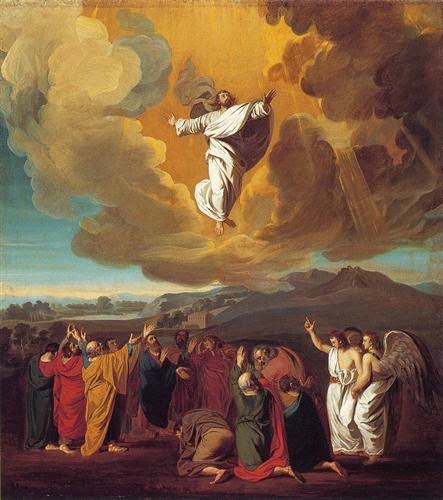
Learning to let go on the feast of Ascension

Jesus ascending to heaven. Painting by John
Singleton Copley (source: Wikipedia)
Have you ever had this fantasy, where Jesus still walks the Earth today – physically, in person? And have you ever imagined the ways you might take just to meet Him? Or, what would you do or say if you chanced upon Him on the street one day? Or maybe, have you ever wished that He did not go back to the Father at all?

My answer is a big ‘Yes’ to all of the questions above.

Why not? Even though I am well aware that Christ is still with us today, in the most personal way, I still need someone with skin, whom I could look up to and learn from. Whose voice I could hear vividly; whose hands I could hold; to whom I could write to for advice... well you know, all along that line. In short, I just want Him to be present physically. Here. On earth. Where I can see Him.

Perhaps, that is why the Feast of Ascension has never been my favourite. Yes, I knew its importance - it was merely a head-knowledge and never heart-knowledge. I imagined myself being with the Apostles, witnessing Him being taken up to Heaven. He said He would be with the Apostles until the end of time, which sounded convincing and the Apostles were hopeful. But wait, who's the Holy Spirit? How long do we have to wait? How can we recognise him? No wonder some of them doubted (Mt 28:17).

I have been questioning the Lord, “What is there to celebrate? You left Your Apostles to fend for themselves!”

The passing of John Paul II changed all that. Oh wait, maybe it was the Canonisation I attended that changed that.

As I mourned the absence of John Paul, a very good friend said this to me: “It is better that he goes back to the Father. Unless he goes back, he would never get to know you. And now that he is a saint, you can be sure that he hears you. You’ve got an intercessor and a friend in Heaven! Is it not better that way?”

This Ascension, I asked the Lord a different set of questions.

If You were physically present in the world today, would I have experienced You the way I did – most intimate and personally? Would I even have the opportunity to meet You face to face, when millions of people fight their way towards You, just like what's been happening at the Vatican with Pope Francis (and particularly at the Canonisation of JPII and John XXIII!)? Could You even reach out to people individually, far and wide, without the coming of the Holy Spirit? Could the Church grow to what she is today?

How crucial it is that Jesus goes back to the Father! How crucial it is that the Holy Spirit is sent!

This year, it is a different Ascension for me. I learned to let go of that sorrow of losing John Paul II. Perhaps, this very reflection also prepares me for the many “letting-go” (and detachment) I have to make in the future, be it people or materials.

It is by letting go that we enable God to give us something even better.

I shall not let Pentecost pass me by this time!

**The popular "Let It Go" song playing in the background**

May 15, 2014

Trip to Rome: An encounter with St Paul

My one and only desire when I went to Rome recently was to witness the canonisation and go to the tomb of St John Paul II to say hello. I've never met him. I'm dying to meet him. By hook or by crook. But unfortunately, no hook nor crook was of help. He was so near and yet so far. In the end, we ended up visiting other places.

I am very thankful to God that we met Fr Peter Hwang, a priest from Bintulu (a town in Sarawak) studying in Rome. He told us that there was another more important and significant historical site than St Peter's Basilica. Of course, I doubted him at first. Why not, since my heart, mind and (most probably) soul, too, wanted to go to St Peter's Basilica only.

It was the Church of St Paul's martyrdom - San Paolo alle Tre Fontane (Church of St Paul at the Three Fountains), taken care by the Trappist monks. Fr Peter brought us into the first Church where St Paul was imprisoned. St Paul managed to write his last letter there, which was to Timothy.

An altar built in front of the cell where St Paul was imprisoned (right)
"That small window (on the right) was the only access to the cell. Imagine how St Paul's persecutors pushed him into the cell and then dragged him out through that little window," Fr Peter explained to us.

I poked my head in to see how it was like. To my horror, it was very cold inside. The ground was rough and uneven. "Oh my gosh..." I heard myself said. "How can anyone sleep in this kind of condition?"

The cell where St Paul was imprisoned
"Yes, it is cold. This is not even winter and it's already so cold. Can you imagine what winter's like inside there?" said Fr Peter. "Yet, St Paul was able to finish his letter to Timothy. He even convinced the person next door to convert and become a Christian."

I felt something stirring deep down inside. 

Before we left the Church, Fr Peter led us in a prayer asking St Paul to intercede for us and to help us be faithful to Christ, just like he did. I guess this place must have meant a lot to Fr Peter somehow.

Out of the chapel we needed to walk along a tar-sealed pathway leading to another church, the site which marked St Paul's beheading (see photo on the left). St Paul could have been dragged all the way from his prison to the place of his execution through that pathway. Certainly, the pathway would not possibly be tar-sealed and smooth like it is today. It could have been rocky, with shrubs and thorns and buttress roots. Perhaps, he could have endured some cuts on his body due to a few falls as he was being forced to the place of 'slaughter'.

How very brutal and inhumane people can be! We wouldn't mind wiping out our enemies as long as they don't stand in our way. But at the same time, we profess our belief in God (regardless of religion). I shuddered at that thought.

"Don't tell me about your God with your words. Show me about your God with your actions" (Steve Maraboli, author of the book Life, the Truth and Being Free). So who is this God you believe in? Pertaining to the persecution of Christians happening recently in this country, I would like to direct this very question to all those who are involved - directly or indirectly.

Church of the Martyrdom of St Paul
Tradition has it that when St Paul was beheaded, his head bounced three times on the sloping ground and at each spot his head landed a spring of water appeared miraculously. The spring of water, which is still flowing today, is called the "Water of Salvation". It was also said that a lot of people who came here to obtain the water received miraculous healing, even until today. Because of the tres fontes (the three fountains) and St Paul's death, Christianity bloomed. However, the Enemy was always present. There were people who wanted to poison the spring of water in attempt to destroy Christianity.

The column on which St Paul was beheaded
Stepping into the next church (i.e. the Church of the Martyrdom of St Paul), there is a column believed to be where the beheading took place, and three 'monuments' (I'm not sure what to call them) under which the "Water of Salvation" (the spring of water) flows. 

I placed my ear near the opening of one of the monuments, trying to hear if there is any sound of flowing water. Nothing. Just the sound of the other visitors' footsteps and voices. I was slightly disappointed when Fr Peter said he could hear the sound of water!

While waiting for the Sacristan Sister to help us get some of the "Water of Salvation" (which were all taken by the group of pilgrims before us), I sat down in front of one of the monuments and had a short conversation with St Paul.

Dearest St Paul, you died defending the faith I so often took for granted. In front of you, I am so ashamed of myself for having so proudly declared that I am a Catholic when my actions did not reflect the identity. Forgive me for all my negligence. Forgive me for taking you for granted as well. Thank you for all you have done for Christ and for his Church. Please pray for us and all the Christians facing persecution all over the world today. And please help me to be faithful to Christ just as you are faithful to him.

'Monument' with water flowing below
Tears were welling up and almost fell. I rubbed my eyes, pretending to feel tired and sleepy as I joined Fr Peter and my friends who were just a few steps away. They were chatting away while waiting for the Sister who promised to bring us some "Water of Salvation".

Fr Peter was right. This is a more important Church that holds the evidence of St Paul's love for Christ. St Paul is more real than ever for me now. He was just one of those biblical authors whom I didn't really bother (for me, the texts were more important, not the authors). But during that visit, a special 'bond of friendship' was formed between St Paul and I (or maybe just me). 

It was an emotional visit, although I did not tell anyone about it, including Fr Peter.

Perhaps, I need to thank John Paul II too. I firmly believe it was through his intercession that we made it to Rome and we were able to save a lot during the trip. Who knows, it was him, too, who sent us Fr Peter to bring us to this Three Fountains Church - to make sure that we don't go to Rome solely for him, but also to get to know The Apostle St Paul and learn from him how to fight a good fight, to finish the course and keep the faith burning for the love of Christ.